
The UP National Institute for Science and Mathematics Education Development (NISMED) recently conducted the 15th to 18th Knowledge Sharing Sessions (KSS) during the second half of 2025 as part of its ongoing internal capacity-building efforts. The KSS serves as a platform for staff to present their research findings, share insights from their studies, and engage in meaningful dialogue with colleagues.
During the sessions, staff share knowledge, experiences, and lessons about research and publications, in support of the Institute's strategic goals of increasing research outputs and improving their dissemination and utilization. They are part of an effort to build a strong, knowledge-driven culture within the Institute. The sessions are held monthly during Research Fridays at NISMED.
The sessions covered diverse topics in mathematics and science education. The 15th session was held on 19 September 2025, when Ms. Abigail B. Gonzales of the High School Mathematics Group presented her research titled Exploring the Potential of Citizen Science in Fostering Mathematical Thinking. The session introduced the concept of citizen science and explored its relevance to education, particularly in science, research, and mathematics. Different types of citizen science projects were presented, alongside examples from the Philippines, to spark dialogue on how such initiatives can be integrated into math and science teaching. The study investigates the role of mathematical thinking—problem solving, reasoning, communication, connections, and representation—within citizen science.
 |
| Staff participate in the Q&A portion during the 15th Knowledge Sharing Session, conducted online on 19 September 2025, with Ms. Gonzales. |
On 24 October 2025, the 16th session highlighted a collaborative research study by Dr. Erlina R. Ronda, Dr. Dennis L. Danipog, and Ms. May R. Chavez titled Enabling and Constraining Factors in Sustaining Lesson Study as a Professional Learning Activity of Teachers: The Case of the Philippines. They presented insights from their study, which they submitted for publication to the International Journal of Lesson and Learning Studies, the official journal of the World Association of Lesson Studies (WALS). During the session, they also encouraged the staff to pursue research related to lesson study, emphasizing its value as a long-term professional development model for teachers.
 |
| Dr. Ronda introduces the research on lesson study and shares information about the World Association of Lesson Studies (WALS) during the 16th Knowledge Sharing Session on 24 October 2025. |
The 17th session was held on 28 November 2025, during which Ms. Ronia Melecia M. Mosaso of the High School Biology Group presented Are You Ready for It? Exploring Change Readiness in Modular Distance Learning. Ms. Mosaso highlighted key findings from her master's thesis, which examines the psychological and structural factors influencing high school science teachers' readiness for change and their acceptance of printed modular distance learning as an alternative mode of science instruction.
 |
| Ms. Mosaso facilitates a Change Bingo activity to help staff reflect on their feelings about change during the 17th Knowledge Sharing Session on 28 November 2025. |
The series concluded for the year with the 18th session on 5 December 2025, where Mr. John Alfred A. Pelenio of the High School Earth Science Group presented Using Design Thinking to Integrate Online Laboratory Activities into Blended Learning. Mr. Pelenio shared key findings from his master's thesis, including a modified design thinking framework designed to guide the integration of online learning activities into blended learning, with the aim of enhancing accessibility, continuity, and preparedness in science education during emergency situations.
 |
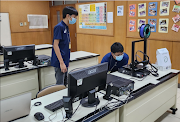
| Mr. Pelenio discusses how science teachers and students perceive the importance of online laboratory activities integrated into blended learning in the context of education in emergencies. |
Through these monthly Knowledge Sharing Sessions, UP NISMED continues to cultivate a supportive and collaborative research community, enabling staff to exchange ideas and contribute to the Institute’s mission of advancing research-based science and mathematics education.


0 Comments