
Eighteen NISMED staff led by the director, Dr. Merle C. Tan, completed a two-day in-house seminar-workshop on Collaborative Content Development using Web 2.0 Tools on December 3 - 4,2009 at the Information Science Lab. The staff development focused on how to leverage Google Docs and wikis to enhance collaborative development work at NISMED. In addition to viewing samples of actual use in education and learning the essentials of Google Docs and wikis, the group had many opportunities to reflect on current practices in content development and on how incorporating Web 2.0 technologies in the processes and tools may improve efficiency and productivity.
In Google Docs, the NISMED staff practiced sharing and collaboratively edit documents and spreadsheets and as output, they identified specific collaborative curriculum projects and activities that can benefit from incorporating Google Docs. Initial ideas included: collaborative lesson planning with partner teachers, end-of-training report writing, on-going work in the science curriculum framework, committee work and report. Some were able to set up Google Docs versions of existing documents and sent out email invitations to collaborators.
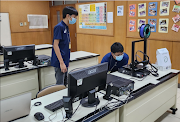
 Ms. Balbin explains the features of Google Docs.
The group was likewise introduced to the features and functionalities of iskWiki!— the UP’s community wiki (http://www.iskwiki.up.edu.ph). As output, they created a wiki to support the Institute’s Assessment for Learning agenda. Dubbed “Assessment-and-Learning-in-SME”, the wiki can be accessed by anyone at http://www.wikispaces.com/Assessment-and-Learning-in-SME, but currently accepts edits only from members.
Aside from the technology sessions, the seminar-workshop likewise included activities that foster collaboration such as the “Find someone who....” exercise and the “NISMED Postage Stamp” activity. In the stamp activity, participants paired up, designed, created, and showcased their original versions of a NISMED commemorative stamp.
Facilitated by Celia Balbin of the Information Science Group, a second run of the seminar-workshop is scheduled in January 2010.


7 Comments
when can i receive my certificate?
That NISMED folks are enthusiastically using the Web 2.0 tools is encouraging-- we may have to award the certificates very soon!
I have proposed that the certificate be awarded not as proof of completing the training ("katibayan ng pagtatapos" in Tina's words) but as evidence that one has applied the newly acquired skills to improve efficiency, productivity, quality of work, and how we collaborate with co-workers.
Yes, everyone who is able to show evidence of utilizing Google Docs and/or a wiki to improve processes and tools in her/his work will receive the certificate. He/she also automatically becomes a member of the Web 2.0 training pool.
I am quite keen in knowing how your HRDO counterpart will receive the new tool-- do keep us posted. Also, if you need help, just say so. :-D